May 05, 2026
Connect With Our Team

Granite Tiles vs Marble Tiles: Key Differences
Choosing between granite tiles and marble tiles is one of the most important decisions homeowners, architects, and contractors make when selecting natural stone flooring options. Both materials are premium, timeless, and widely used across residential and commercial projects in India.
This guide breaks down the difference between granite and marble tiles for flooring, kitchen countertops, high-traffic areas, pricing trends, and maintenance best practices so you can make a confident decision.
Understanding Granite Tiles and Marble Tiles
What Are Granite Tiles? Formation, Hardness & Strength
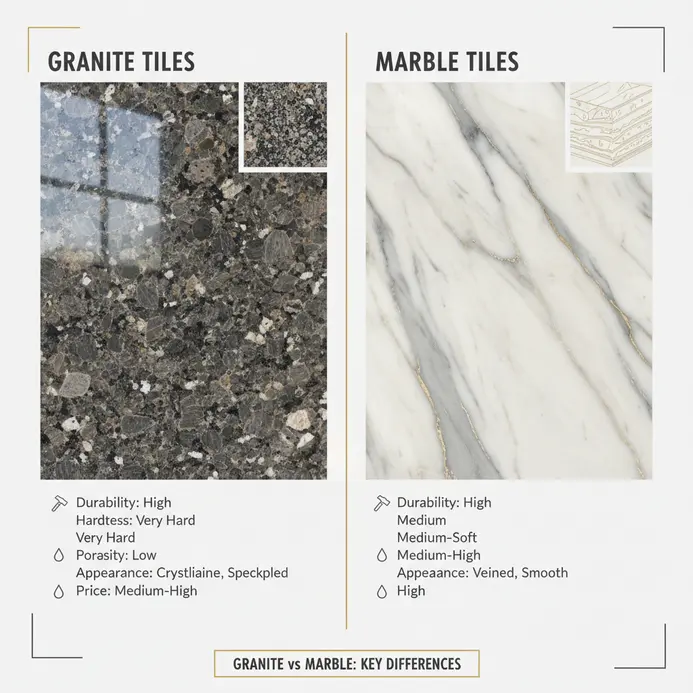
Granite is an igneous rock formed from cooled magma beneath the Earth’s surface. This natural formation gives granite exceptional density and structural integrity.
On the stone tile hardness scale, granite typically ranks between 6 and 7. This explains its outstanding granite durability and scratch resistance, making it ideal for heavy-use spaces.
- High compressive strength: Excellent for commercial flooring.
- Low porosity: Better stain resistance compared to marble.
- Wide design variety: Rich granite color variations and textures.
- Export-ready quality: India produces export quality granite slabs used globally.
Based on extensive industry work, granite consistently outperforms in high-load environments like malls, airports, and hotel lobbies.
What Are Marble Tiles? Composition, Porosity & Aesthetics
Marble is a metamorphic rock formed from limestone subjected to intense heat and pressure. Its signature appeal lies in its soft veining patterns in marble, creating a luxurious and elegant finish.
However, marble porosity and stain resistance remain key concerns. Marble is softer, ranking between 3 and 5 on the Mohs scale.
- Elegant veining: Ideal for luxury interiors.
- Softer surface: More prone to scratches and etching.
- Higher porosity: Requires regular sealing natural stone tiles.
Leading marble tiles suppliers exporters in India provide premium-grade options for upscale residential and hospitality projects.
Engineered Marble vs Natural Granite Tiles
The comparison of engineered marble vs natural granite tiles often arises in commercial tenders. Engineered stone tiles vs natural stone differ in composition and performance.
- Engineered marble: Uniform look, controlled porosity.
- Natural granite: Superior strength and authenticity.
- Commercial preference: Granite dominates heavy-traffic zones.
Granite Tiles vs Marble Tiles for Flooring: Durability, Traffic & Performance
Best Tiles for High Traffic Areas: Granite or Marble?
For anyone asking about the best flooring tile for high traffic areas granite or marble, the answer is clear from field performance data. Granite is significantly more durable.
- Better impact resistance
- Higher scratch tolerance
- Lower long-term maintenance cost
Granite Tiles for Bathroom Walls and Floors
Granite tiles for bathroom walls and floors perform exceptionally well due to low water absorption. When properly sealed, they resist moisture penetration and staining.
Marble can be used in bathrooms, but sealing natural stone tiles becomes mandatory to prevent discoloration.
Difference Between Granite and Marble Tiles for Flooring
- Scratch Resistance: Granite wins.
- Stain Resistance: Granite performs better due to lower porosity.
- Lifespan: Granite often exceeds 25+ years in commercial flooring.
- Maintenance: Marble requires more frequent sealing.
Granite vs Marble for Kitchen Countertops
Heat Resistance & Scratch Performance in Indian Kitchens
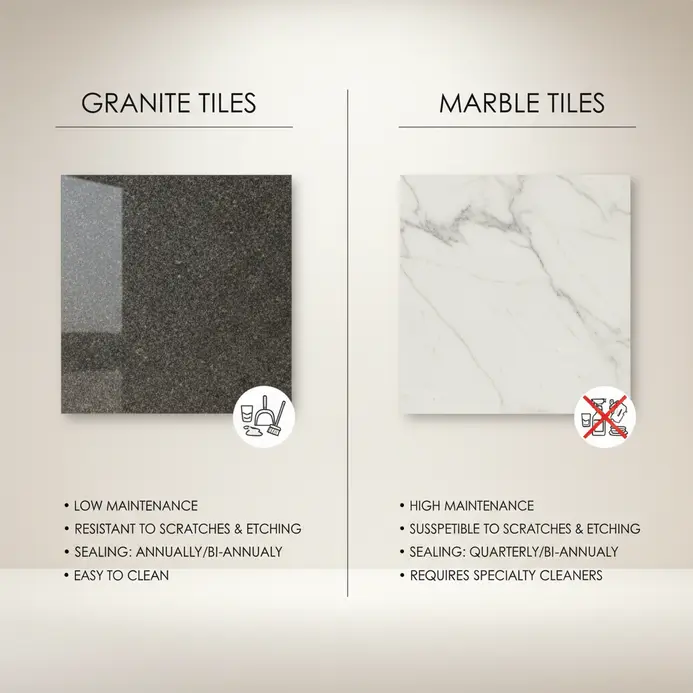
When evaluating granite vs marble for kitchen countertops, durability under heat and daily cooking stress matters. Indian kitchens involve high temperatures, spices, oils, and acidic ingredients.
Granite handles hot utensils and sharp tools far better. Marble frequently shows etching from lemon and vinegar exposure.
Marble Porosity vs Granite Durability
Acid sensitivity is marble’s biggest drawback. Over time, stains and dull patches appear without consistent sealing.
Granite’s structure provides better long-term resilience with minimal intervention.
Polished Granite Tiles vs Honed Marble Finish
The debate between polished granite tiles vs honed marble finish depends on application and design goals.
- Polished granite: Glossy finish, highly stain-resistant.
- Honed marble: Matte look, hides scratches but stains faster.
- Honed finish vs polished finish stone tiles: Polished offers easier maintenance.
Cost Comparison
Granite Tiles Price Per Square Foot India
The granite tiles price per square foot in India typically ranges from budget domestic varieties to premium export-grade selections.
- Domestic granite: Affordable and durable.
- Premium granite: Higher cost, superior finish.
- Granite tile sample orders for architects: Essential before bulk procurement.
Marble Pricing Factors
Marble pricing varies based on origin, grading, and transport logistics. Premium white marble commands significantly higher pricing.
Working with reliable marble tiles manufacturer & suppliers ensures grading transparency.
Long-Term Value: Which Stone Offers Better ROI?
Granite usually delivers stronger ROI due to lower maintenance frequency and longer lifespan. In commercial projects, replacement costs heavily influence material choice.
Maintenance & Sealing Guide: Marble Tiles vs Granite Tiles
Marble Tiles Maintenance and Sealing Guide
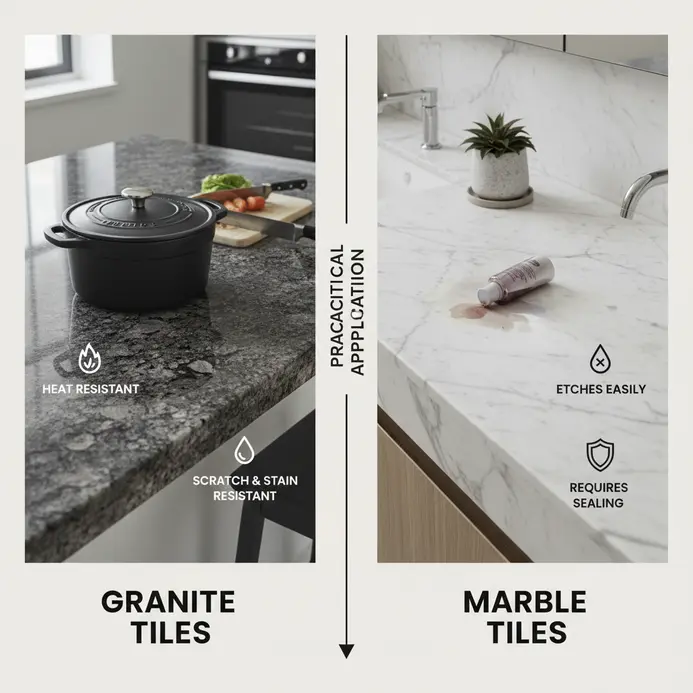
A proper marble tiles maintenance and sealing guide includes sealing every 6-12 months depending on usage.
- Avoid acidic cleaners.
- Use pH-neutral solutions.
- Seal joints carefully.
Granite Maintenance Best Practices
Granite requires less frequent sealing but still benefits from periodic protection.
- Seal every 1-2 years.
- Use microfiber cleaning tools.
- Professional polishing every few years for commercial sites.
Common Mistakes to Avoid
- Skipping sealing cycles.
- Using harsh acids.
- Poor installation of stone tiles commercial projects.
How to Choose the Right Supplier in India
What to Look for in Granite Tiles Wholesale India
- Consistent slab thickness
- Quality certification
- Access to export-quality granite slabs for tiles in India
Evaluating Marble Tile Exporters India
- Grading transparency
- Moisture testing reports
- Experience in global exports
Questions Before You Buy Granite Tiles in Bulk Online India
- Is sealing required before dispatch?
- What is the wastage percentage?
- Are sample tiles available?
Conclusion
The choice between granite tiles and marble tiles ultimately depends on application, budget, and maintenance expectations. For durability and commercial performance, granite is the superior option.
For luxury aesthetics and statement interiors, marble remains unmatched. Granite offers better long-term ROI, while marble delivers timeless elegance when properly maintained.
Explore premium collections of granite tiles and marble tiles at Harsha Tiles to find the perfect natural stone solution for your project.
FAQs
1. Which is better for flooring: granite tiles or marble tiles?
Granite tiles are generally better for flooring in high-traffic areas due to superior hardness and scratch resistance. Marble tiles are ideal for low-traffic luxury interiors where aesthetics matter more than durability.
2. What is the difference between granite and marble tiles for flooring?
The main difference between granite and marble tiles for flooring lies in hardness and porosity. Granite is denser and more stain-resistant, while marble is softer and requires regular sealing.
3. Which is more expensive in India - granite or marble tiles?
Marble is often more expensive, especially imported varieties. However, premium granite can also command high prices depending on color and rarity.
4. Are granite tiles easier to maintain than marble tiles?
Yes. Granite tiles require less frequent sealing and are more resistant to stains and scratches compared to marble tiles.


Whatsapp Chatx
Hi! Click one of our representatives below to chat on WhatsApp or send us email to info@harshatiles.in
 |
Mr Saleem +91 82702 80707 |
|
Mr Subramanian +91 96265 57655 |
 Design Your Dream Home